By Nanette Kubena
The trailer for the film Ever After: A Cinderella Story (1998), directed by Andy Tennant and released by 20th Century Fox
Although the film Ever After: A Cinderella Story (1998) is set at the beginning of the Renaissance, the film sets out to challenge the ideology and social norms of an imagined medieval period, and as such it works as a commentary on medievalism. The film begins with the Grimm brothers meeting a woman who claims to be the descendent of the true Cinderella and wants to ensure they have the story correct. A retelling of the classic Cinderella fairy tale, which itself was part of the Grimm brothers’ attempts to recover a medieval past in recording “traditional” folk tales.
The next scenes in the movie depict a wealthy man bringing home his new bride, a Baroness, and her daughters to his manor to meet his daughter. Tragically, he dies of a heart attack soon after. This is the first attempt of the film to establish the social norms of the Middle Ages and to establish the protagonist. As Bettina Bildhauer explains in her chapter on Cinematic Medievalism, many medieval films, especially those retelling fairy tales, pay particular attention the childhood of the protagonist (57). The remarriage of widows and widowers in the Middle Ages was also common and threatened the inheritances of children born from previous marriages, and so these fairy tales echo these anxieties as well. The Baroness and her children are lavishly dressed, one might say overdressed and display mannerisms very different from the wealthy man and his daughter. These mannerisms are displayed throughout the film even after the family is destitute. The sense of privilege the Baroness and her daughters display is related to the entitlement of nobility, to which they aspire, while the main character Danielle, the protagonist, is treated as a servant now that her wealthy father is no longer alive. The conflict of personal integrity and how it clashes with social or class privilege is a running theme throughout the film.
Ever After allows, as Robert Rosenstone put it, for historical “thinking.” Historical “thinking” allows the audience to come to grips with issues from our past in films, that “challenge us in the present – questions of social change, gender relations, individual and group identity, class, ethnicity war, colonialism, revolution, ideology and nationalism” (Rosenstone, 73). In the film, for example, Henry, the prince, is reminded of his “national” duty to King and Country that requires him to marry and produce a male heir. The King reminds Henry that his marriage is a “treaty, not about love.” Eventually, the King informs Henry he can marry for love but must marry soon. As the film progresses, it is clear to the audience that Henry can marry for love, but his love must be of noble birth. Invitations to a royal ball are sent far and wide. Henry is to announce his choice at the ball. In one scene, Danielle is excited to go to the ball even though this is a royal function in which commoners are not allowed, only those of noble blood. In this sense, the film questions how a medieval sense of traditional duty can go against our more modern notions of romantic attachment and love.
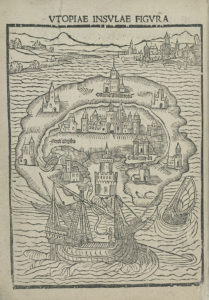
A woodcut drawing of Thomas More’s Utopia (1516), courtesy of the British Library
Danielle accidently meets the future king while disguised as courtier. She is reminded that the punishment for dressing above one’s station is five days in the stock, but takes the risk to rescue a beloved elderly servant that was sold to pay taxes. She is also reminded that her dress is not the only element of her disguise. Her attitude must reflect nobility: “Look down to no one.” In this scene, Danielle challenges the Prince and consequently “medieval” ideals by quoting Thomas More’s Utopia (1516). Danielle asks if he bothers to converse with those below his station and he replies no. She explains that society, not individual action, has placed people in positions less fortunate than others, and it is only their lot in life that has prevented them from ascending the social ladder. The prince is intrigued and clearly attracted to the young “courtier.” This again challenges the norms of the Middle Ages. According to Heather Dupont, “men of the time period have been portrayed to fall for the more reserved women instead of women who openly expressed their opinions” (Dupont 2015).
Another aspect of the film that challenges the norms of the Middle Ages is the introduction of Leonardo DaVinci, who stands in for a more progressive age. DaVinci is portrayed as eccentric, albeit enlightened. His words and deeds throughout the film challenge societal norms of the Middle Ages. He creates flying objects and shoes that allow him to walk on water. He discusses love with the Henry and espouses the idea of a person’s “match” both in words and deeds. Henry reminds him, “I have been born to privilege and with that comes obligations.” DaVinci represents the Renaissance and its challenge to the Middle Ages. The addition of DaVinci is very clever because he is an easily recognizable character, especially in one scene in which he unfurls his most famous work – the Mona Lisa.
Through dialogue and interactions with Danielle, Henry himself becomes enlightened. He invites the Gypsies to the ball and his new project is to open a university with a library open to all people. During the Middle Ages the written word was reserved for those of wealth and privilege. Thus, Henry’s project directly challenges “medieval” ideas about tradition and preserving privilege.
Eventually, the King, the Queen and Henry turn their backs on the archaic norms of the Middle Ages and Henry is allowed to marry Danielle. And they lived happily, Ever After.
Bibliography
Bildhauer, Bettina. “Medievalism and Cinema.” In Cambridge Companion to Medievalism, edited by Louise D’Arcens, 45-49. Cambridge, 2016.
Dupont, Heather. “If the Shoe Fits: An Analysis of Historical and Contemporary Adaptations of Cinderella.” Undergraduate Honors Thesis, Bridgewater State University, 2015.
Rosenstone, Robert A. “The Reel Joan of Arc: Reflections on the Theory and Practice of the Historical Film.” The Public Historian 25, no. 3 (2003): 61-77.