
By Gul Musavi
Assassin’s Creed is an action-packed video game series depicting the intense conflicts between two secret societies, the Assassins and The Knights Templar. The games were released by Ubisoft developers. The first game was released on November 13, 2007 followed by several other releases.
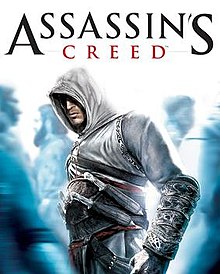
The cover of the Assassin’s Creed video game (2007)
Daniel T. Kline summarizes the game as involving “[…] protagonist Desmond Miles inhabit[ing] the consciousness of Altair ibn-La’Ahad, an assassin during the Third Crusade, as he gallivants around the Near East in battle against the machinations of the Knights Templar, who persist in the guise of the Abstergo corporation”(Kline, 75). The first Assassin’s Creed game shows how the Assassins were in conflict with the Templars. The game mainly follows the Assassins, who are based on the historical Hashshashin sect, and their attempts at assassinating political figures in Acre, Damascus, and Jerusalem. The political conflicts during the Third Crusade creates an environment in which the main character Desmond Miles can demonstrate his expertise in carrying out assassinations.
While it depicts historical details about the Hashshashins, the game embellishes history with fictional storylines. In reality, the Hashshashins were wiped out of Syria and Iran after the Mongol army attacked their headquarters in both countries. In the game series, the Assassins continue their work to this very day.
Overall this type of fantasy game also has role-playing elements in it, making players feel “[…] a more satisfyingly ‘realistic’ game experience,” as William J. White has said of other medieval RPGs. The game allows players to traverse through the medieval societies of Acre, Jerusalem, and Damascus, following the character through the city, which gives the player a “real-world” experience of medieval cities.

Side-by-side comparison of present-day Jerusalem with medieval Jerusalem in the game Assassin’s Creed (2007), as juxtaposed by YouTuber Cycu1
Carrying out missions in the game also allows users to “handle” the weaponry of a twelfth century world. The division in social classes in the game is shown when navigating through specific missions. The procedure adopted when chasing someone on the street is very different from targeting a high-profile target. The game makes it obvious that the living standards of medieval people varied significantly based off their rank in society. Though it makes claim to some sort of historicity, the characters in the game are mostly fictional and several aspects of the game are highly stylized, like the wearing of hoodies when the Assassins carry out assassinations.
The game is not as explicitly violent as others in the same genre, as players need to be careful when navigating the stealth missions that make up much of the gameplay. The game, as a work of medievalism, plays with our ideas of what a civilized, but violent, “medieval” society would look like during a time of war and intrigue. The cutthroat (figurative and literal) politics of this world serves to place our modern world into perspective. The “medieval” world of Assassin’s Creed is, indeed, alien to our eyes.
Bibliography
Kline, Daniel T. “Participatory medievalism, role-playing, and digital gaming.” In The Cambridge Companion to Medievalism, edited by Louise D’Arcens, 75-88. Cambridge, 2016.
White, J. William. “The Right to Dream of the Middle Ages: Simulating the Medieval in Tabletop RPGs.” In Digital Gaming Re-Imagines the Middle Ages, edited by Daniel Kline, 15-30. London: Routledge, 2014.