By Adam Mahan
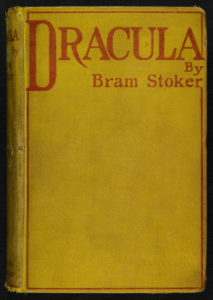
Cover of the first edition of Stoker’s Dracula, courtesy of the British Library
There is arguably no more iconic figure to come out of nineteenth-century England than Bram Stoker’s Count Dracula, the titular character of the Gothic epistolary novel, Dracula (1897). His infamous vampire has spawned numerous adaptations and has influenced a litany of vampiric reimaginings in literature, film, and popular culture throughout the twentieth and twenty first centuries.
There is no doubt that the inspiration for Stoker’s Dracula was the fifteenth-century line of Wallachian princes. Andrew William Collins notes the influence of the “Dracula dynasty” in Stoker’s work, beginning with Vlad II Dracul and followed by his son Vlad Tepes II, infamously known as the Impaler. Collins demonstrates, citing the novel, that Stoker’s Dracula was not the same figure as the historical Wallachian princes, but rather a distinctly fictitious descendant of the “Dracula dynasty” (Collins). The origins of this dynasty, as Stoker’s Dracula relates, were rooted in the Turkish conquests in Eastern Europe, “when the flags of the Wallach and Magyar went down beneath the Crescent” (Stoker, 36).
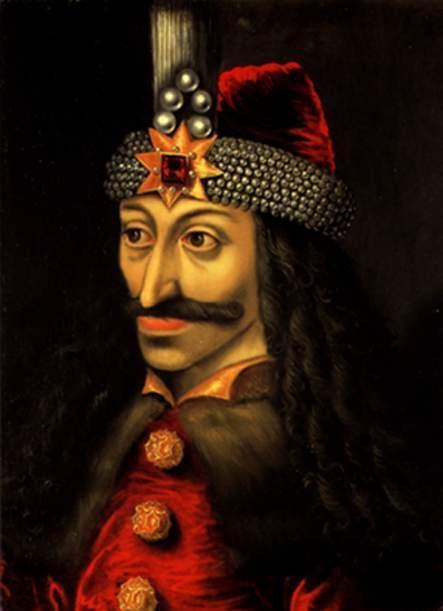
Although neither Stoker nor his Dracula mention the etymology of “Dracula,” Dracul appears to be the surname assumed by Vlad Tepes I after his induction into the Order of the Dragon society by the Holy Roman Emperor, Sigismund. The purpose of this military order was to defend Christendom against the Ottoman Turks, against whom Europe was battling (Pallardy). This tumultuous conflict is passionately related by Dracula to Harker, lamenting that it was his ancestors who “for centuries was trusted the guarding of the frontier of Turkeyland…endless duty of the frontier guard” (Stoker, 36).

Stoker firmly establishes his Dracula as a descendant of medieval Europe, from a line of Dragons entrusted with defending the borders of Christendom. Literary scholar Clare Simmons relates that while Gothic fiction employed medievalist elements, its tales were rarely set in the medieval period (108). Stoker also did not set his tale in the medieval period, but rather embedded the medieval into his modern-day tale. While Stoker’s Dracula is both descended from and appears to live in a medieval period, the setting for his novel is an industrial Europe on the cusp of the twentieth century. Stoker was able to transport his readers from a religiously superstitious Eastern European, “medieval” past to a sophisticated, civilized, present-day (1897) England. Stoker bridged the gap between what Richard Utz describes as a “temporal distance and perceived civilisatory superiority to an unenlightened and ‘barbarous’ past” (Utz, 121).
Bram Stoker’s story begins with Jonathan Harker departing London for the eastern Carpathians. His journey through Europe toward the castle of Count Dracula is a sort of travelling back in time, with a horse carriage as time machine, transporting him from civilized, “enlightened” England to a backward, “gloomy” Europe, still caught up in the superstitions of the Middle Ages. Initially, Harker regards the oddities of the people he encounters as merely superstitions. As he writes in his diary, he relates that he was gifted a rosary because at midnight “all the evil things in the world will have full sway” (Stoker, 10). He accepted it out of kindness, but still regarded it as idolatrous superstition. The next day, en route to the castle, Harker observes more odd behavior from bystanders, crossing and pointing, which a “fellow-passenger” explained “was a charm or guard against the evil eye” — “I must ask the Count about these superstitions,” he writes as a reminder (12). Simmons states that ignorant superstitions were seen to have been perpetuated by an oppressive Roman Catholic Church, and as such were key elements in Romantic and Gothic medievalist literature (Simmons, 107).

Harker’s journey into the “unenlightened past” is reinforced by the increasing darkness in which he travels, from west to east. By the time he is on the final stretch on the trip, alone in the Count’s coach, there are no lights save a single match he strikes to illuminate his watch, the coach’s lamp, and the ominous blue flames which sporadically pop up along the road. The journey from civilized society to medieval past is complete upon his arrival to Dracula’s “vast ruined castle, from whose tall black windows came no ray of light, and whose broken battlements showed a jagged line against the moonlit sky” (20).
Bibliography
Collins, Andrew W. “The Originality of Bram Stoker’s Character Count Dracula: An Addendum.” Notes and Queries 61, no. 1 (2014): 108-112.
Pallardy, Richard. “Vlad the Impaler Ruler of Wallachia.” Encyclopedia Britannica.
Simmons, Clare A. “Romantic medievalism.” In The Cambridge Companion to Medievalism, edited by Louise D’Arcens. Cambridge, 2016.
Stoker, Bram. Dracula. New York, 1897.
Utz, Richard. “Academic medievalism and nationalism.” In The Cambridge Companion to Medievalism, edited by Louise D’Arcens. Cambridge, 2016.